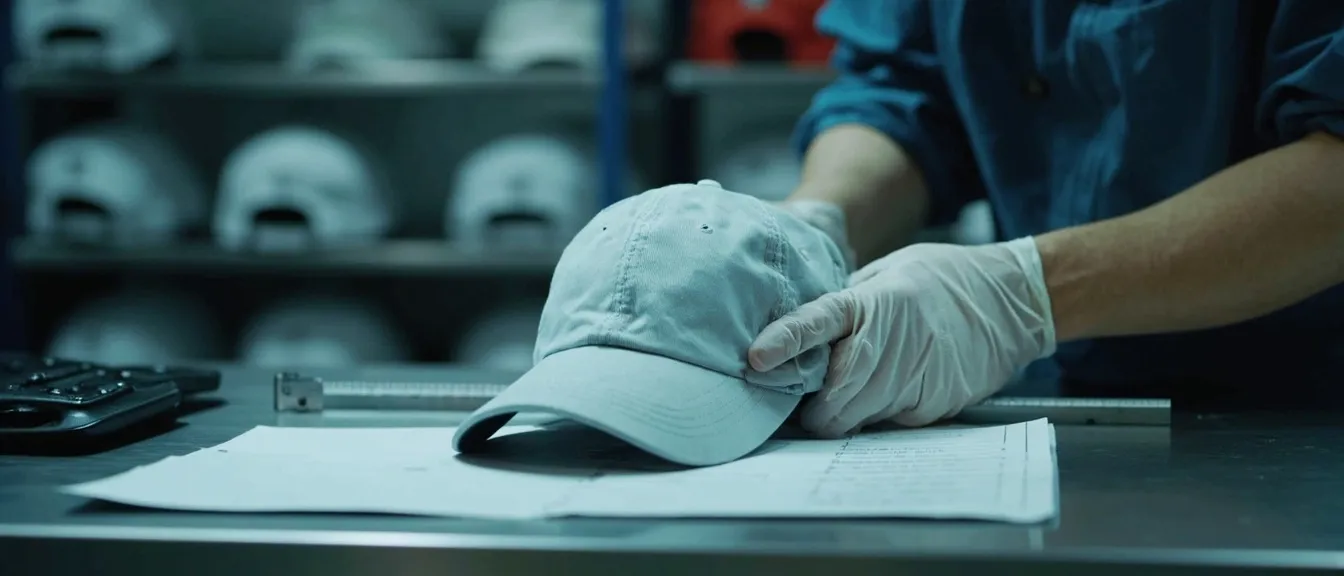
Approval before production. Inspection against your specification.
The approved physical sample is the production reference. Inspection levels, testing and documentation are agreed for each order instead of assumed.
Bad caps are decided before production starts
Almost every headwear failure traces back upstream: a vague specification, a sample nobody signed off, a construction that was never validated in physical form. We close those gaps before a single panel is cut. Quality at Gazelle is not a final inspection that sorts good caps from bad. It is a sequence of decisions that makes the bad version unlikely in the first place.
The pages buyers actually need are simple to state: what the cap is made of, how it is built, what the approved sample looks like, where it will be inspected, and which documents apply to the destination market. We confirm all of them in writing and against a physical object, because a render and a description are not a production standard.
01 — We write the specification down
Before sampling we lock the variables that drive both price and appearance: panel count, crown profile (structured or unstructured, high-, mid- or low-profile), brim shape and width, closure type, fabric composition and weight, colour against an agreed standard, artwork files and dimensions, decoration method, labels, swing tags and packaging. Pantone or a physical colour standard is agreed rather than a name on an email.
Anything ambiguous is resolved at this stage, not discovered on the line. A 3D puff logo on a soft unstructured front behaves differently from the same logo on a fused front; a metal buckle and a plastic snap imply different fittings; a licensed retail programme and a giveaway promotion imply different tolerances. The specification is where those differences are decided once, not argued about twice.
02 — We make you a real sample
Samples can be ready as fast as 3 days on standard constructions with available materials. The sample is where you find out how the crown holds its shape, how the brim curves, how the stitching sits and how your logo actually reads on that particular fabric, colour and panel size. We photograph the sample and ship it for physical approval wherever possible; colour and crown shape should be judged in the hand, not on a screen.
Custom-dyed materials, new moulds, leather or woven patches, appliqué and licensed artwork take longer, and we say so before the project starts rather than after. A sample that needs a revision is normal and cheaper than a container that does. We record what changed between rounds so the approved version is unambiguous.
03 — Your signature becomes the standard
Once approved, the sealed sample is the reference the bulk is checked against — not a render, not a verbal description, not "like last time." The production team, the line and final QC all work to the same physical object and the written spec. That is what protects a repeat order from drifting: colour, weight, panel alignment, logo position and finish are compared to the thing the customer actually approved.
04 — Inspection at the points that matter
Inspection is staged rather than left to the end: incoming materials are checked for colour, weight and defects; in-line work catches construction and decoration issues while they can still be corrected; finished goods are assessed for appearance, dimensions, stitching, decoration, labels and packing. Inspection level and the sampling plan (for example an AQL-based plan) are agreed per order, because a promotional 5,000-piece run and a licensed retail programme are not the same risk and should not share the same plan.
Third-party inspection is welcome. Tell us the standard and timing at the order stage and we will set line access and documentation accordingly. We would rather plan for an independent visit than scramble for one after the goods are packed.
05 — Testing scoped to your market
Restricted substances, fibre labelling, children's-product requirements and destination documentation vary by market and by customer programme. During the enquiry we confirm which tests actually apply to your product and destination — such as restricted-substance or material-content testing where required — instead of attaching a generic certificate that proves nothing about your order. Relevant documents are issued against the producing legal entity and site, with scope and dates that match the shipment.
What we will not do
We will not publish a universal defect rate, a blanket on-time percentage, or claim that one AQL level covers every order. Those numbers move with construction, decoration, quantity and programme; quoting a single impressive figure would be marketing, not manufacturing. What we commit to is a process: a written specification, an approved physical sample, an agreed inspection plan and documented results you can audit.
Compliance and audits
- Social: amfori BSCI, SEDEX SMETA and Better Work engagement on applicable sites.
- Material and facility: GRS recycled-content chain of custody and HIGG facility assessment where the programme applies.
- Licensed production: Disney FAMA and NBCUniversal vendor approval and licensing workflows for authorised programmes.
Request the documents for your programme and we will confirm the legal entity, site, scope and validity dates that actually apply rather than sending a generic folder. If a certificate you need is not currently in place for a specific site, we will tell you that directly and discuss timing before you commit.
Frequently asked questions
Do you provide a pre-production sample before bulk?
Yes. We produce a physical pre-production sample for your approval against the written specification; standard constructions with available materials can be sampled as fast as 3 days. The approved sample becomes the reference for bulk production.
What inspection standard do you use?
Inspection points and sampling plans are agreed per order based on the product, quantity, destination and risk. Many retail and licensed programmes use an AQL-based plan, and we welcome customer or third-party inspection with access arranged in advance.
Which compliance certificates do you have?
Applicable sites support amfori BSCI, SEDEX SMETA and Better Work, with GRS recycled-content and HIGG facility documentation where relevant, plus Disney FAMA and NBCUniversal workflows for licensed programmes. We confirm the exact entity, site, scope and dates for your order instead of sending generic certificates.
Can an independent third-party inspector visit the factory?
Yes. Provide the standard and preferred timing at the order stage and we will arrange line or final-inspection access and the supporting documentation for the inspector.
How do you control colour, logo placement and workmanship?
Colour is agreed against a Pantone or physical standard, logo placement and dimensions are fixed in the specification, and bulk is checked against the sealed approved sample at incoming, in-line and finished-goods stages.